Additive manufacturing is growing. The money is moving to “proof” and “shipping.”
With services now 48% of AM revenue, can printers win the work around 3D printing—quality certificates, sealing, and pack-ins—rather than the build itself?
3D printing (additive manufacturing) is drifting from a race in machine performance to a race in the paperwork and logistics that make manufacturing “real.” The market is expanding, yet equipment players are taking impairments and a legacy service bureau has collapsed. For printing companies, the prize is not stacking resin or metal—it’s editing finished parts into a shippable product.
Gathered with AI. Thought through on the shop floor. Written for the future of print.
BPJ WIRE: stories selected and drafted by the BPJ desk from world news, fact-checked against the source ledger — published alongside the editor's own picks.
Translated from Japanese by AI. The Japanese original is authoritative.
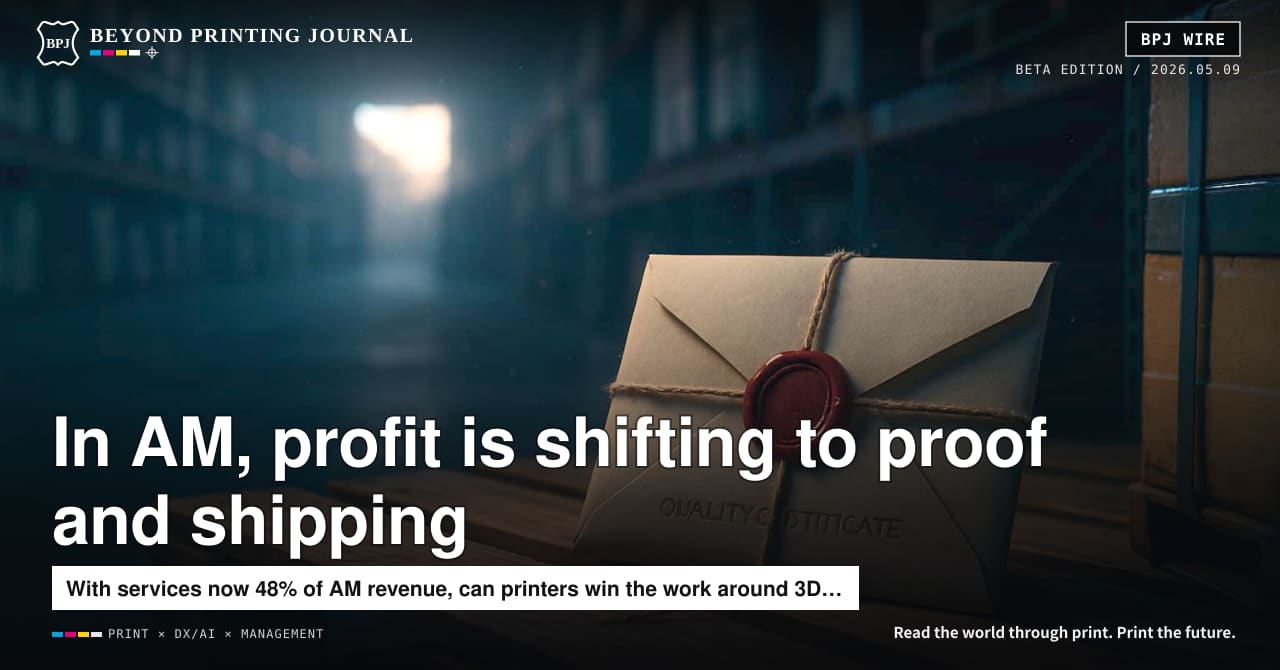
There are cases in aerospace metal 3D printing where the build is finished—but shipping stops anyway. The cause is not a bad build. It’s that the “paper” needed before the box can close isn’t complete.
“Not enough paper” here does not mean someone ran out of printer stock. It means the inspection report, material lot certificate, and the bundle of process-history records meant to be slipped into the clear document pouch next to the shipping carton are stuck on someone’s…
The rest is for members
Read the full article. Our feature reports also carry an archive-grade one-page brief (BPJ VISUAL BRIEF) — every figure with its source.
Already a member? Log in
Sources
Beyond Printing Journal — read the world through print, and print the future.