Japan recovers 81% of its waste paper—and still has too much. Who eats the loss?
As exports thin out and newsprint/printing paper demand shrinks, only collection inertia remains. Read the supply–demand mismatch in containerboard vs. printing grades by following who pays, and when.
Recovered paper was supposed to be a “scarce resource.” Yet in Japan, even with a high recovery rate, the industry is starting to talk openly about surplus volumes and negative-value transactions—where collectors must pay to get material taken away. The key isn’t “how much,” but grade, quality, and a clogged export channel. The end-markets for containerboard (packaging) and printing paper (publishing and commercial) are shaped differently—and that difference is now showing up as a mismatch.
Gathered with AI. Thought through on the shop floor. Written for the future of print.
BPJ WIRE: stories selected and drafted by the BPJ desk from world news, fact-checked against the source ledger — published alongside the editor's own picks.
Translated from Japanese by AI. The Japanese original is authoritative.
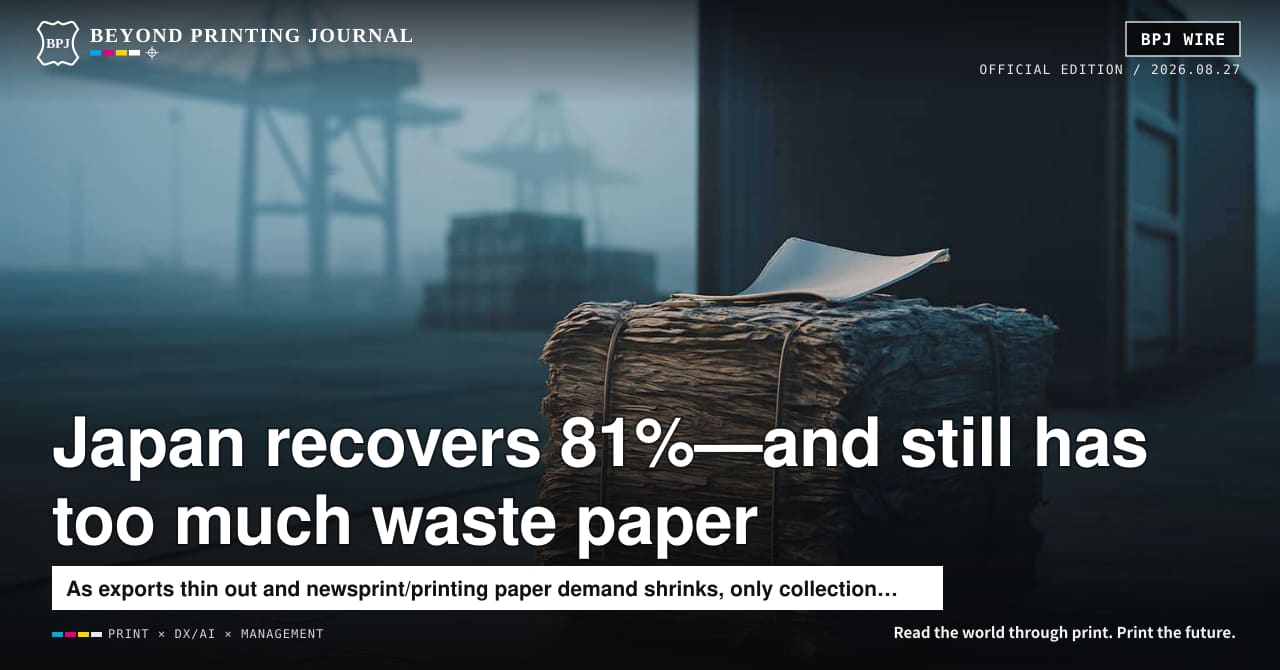
Bales of recovered paper (compressed bundles) aren’t piling up only behind mills. They stall at ports, sit idle in warehouses, and finally push the system toward a decision nobody wants to make: “stop collecting.” A Tokyo-based waste-management industry group notes falling recovered-paper prices, an increase in negative-value transactions, and cases of collection being halted or businesses suspending operations.…
The rest is for members
Read the full article. Our feature reports also carry an archive-grade one-page brief (BPJ VISUAL BRIEF) — every figure with its source.
Already a member? Log in
Sources
Beyond Printing Journal — read the world through print, and print the future.