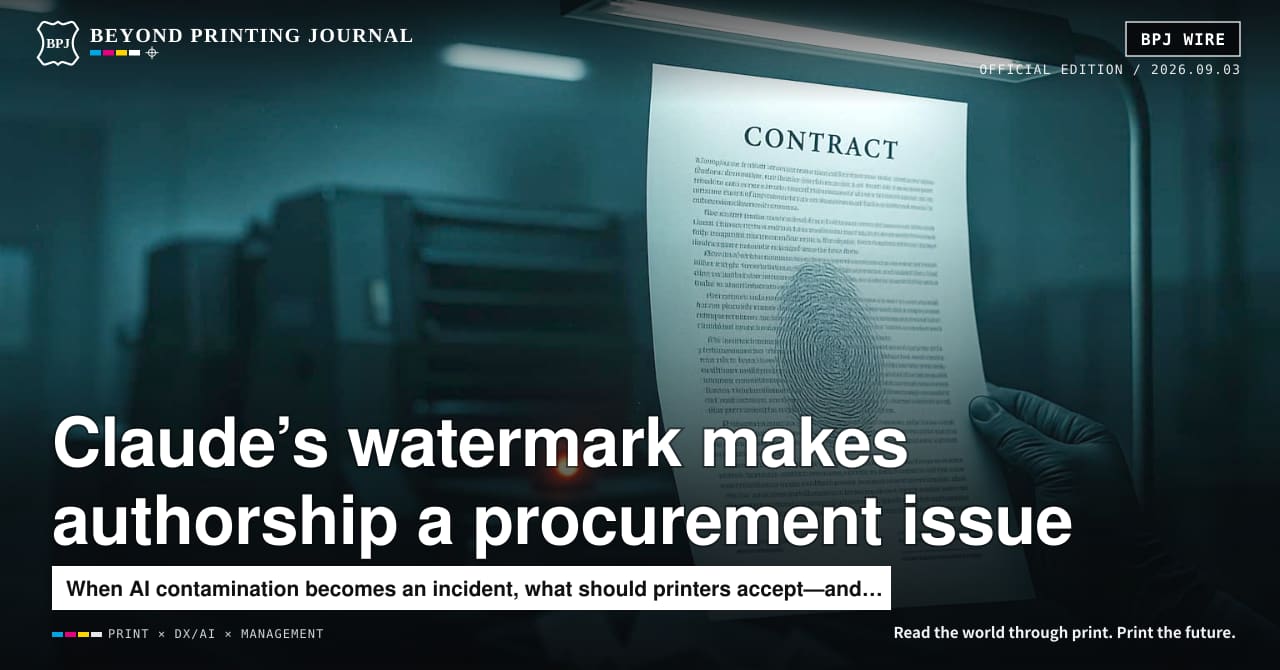
Claude’s “watermark” shifts the question from “when was this written?” to “whose writing is this?”
When AI contamination becomes an incident, what should printers accept—and refuse—before ink ever hits paper in contracts, manuals, and catalogs?
One swapped sentence at the end can become a quality incident. And when that sentence comes from generative AI rather than a person, the argument is no longer “typo or not,” but provenance and accountability. As Claude moves toward statistical watermarking, print production workflows—intake → proofreading → approval → version control—are quietly being replaced by a different set of rules.
Gathered with AI. Thought through on the shop floor. Written for the future of print.
BPJ WIRE: stories selected and drafted by the BPJ desk from world news, fact-checked against the source ledger — published alongside the editor's own picks.
Translated from Japanese by AI. The Japanese original is authoritative.
Anthropic is presenting “watermark” and a “detection API” as a pair
Anthropic has explained a policy of adding a statistically detectable mark (statistical watermarking) at the model level to Claude’s outputs. In addition, it says it plans to provide a watermark detection API and expand access in phases.…
The rest is for members
Read the full article. Our feature reports also carry an archive-grade one-page brief (BPJ VISUAL BRIEF) — every figure with its source.
Already a member? Log in
Sources
Beyond Printing Journal — read the world through print, and print the future.