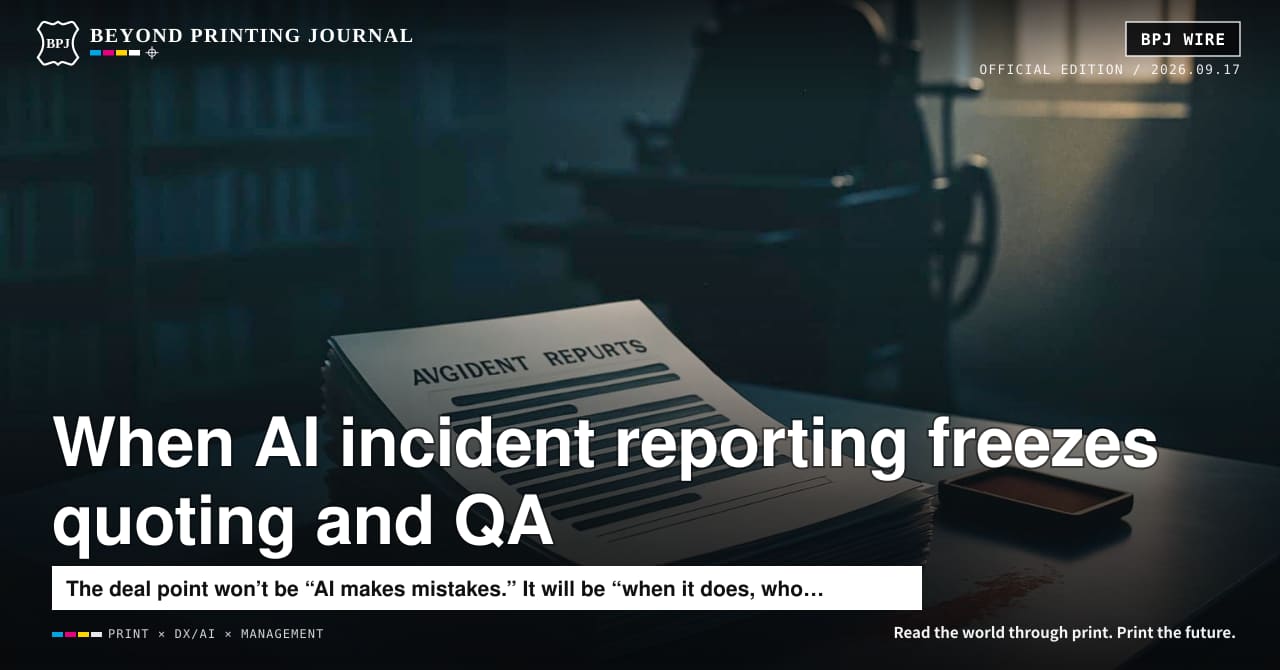
The day an “AI incident report template” freezes quoting, inspection, and customer service
The deal point won’t be “AI makes mistakes.” It will be “when it does, who stops it—and who can explain it.”
The deeper AI goes into day-to-day operations, the evaluation shifts from whether an incident happened to whether you could stop it in time—and explain it after. OpenAI’s newly published misalignment reporting framework treats AI incidents more broadly than “security breaches,” and pairs a fixed template with case reporting as an operating rhythm. For printers embedding AI into quoting, inspection, and customer support, that template quietly moves the boundary of responsibility—and where gross margin sits.
Gathered with AI. Thought through on the shop floor. Written for the future of print.
BPJ WIRE: stories selected and drafted by the BPJ desk from world news, fact-checked against the source ledger — published alongside the editor's own picks.
Translated from Japanese by AI. The Japanese original is authoritative.
On a job that comes in with “same as last time,” an auto-reply quote can end up applying the same cost structure as last time. Paper stock has changed. A subcontractor has raised unit prices. But before sales even feels the mismatch, a number goes back to the customer.…
The rest is for members
Read the full article. Our feature reports also carry an archive-grade one-page brief (BPJ VISUAL BRIEF) — every figure with its source.
Already a member? Log in
Sources
- OpenAI - Our framework for reporting model misalignment
- EUR-Lex - Regulation (EU) 2024/1689 (consolidated view) / 2026-07-27
- OpenAI - The Hugging Face incident and the road ahead
- TCSA - ISO 27001 Control 8.15 Logging
- European Commission - digital-strategy.europa.eu FAQ (GPAI obligations)
- logpulse.io - ISO 27001 logging requirements (guide)
- kikakurui.com - JIS Q 27001:2014-01
Beyond Printing Journal — read the world through print, and print the future.