Japan’s unmanned cargo-handling plan assumes a 20 cm stop tolerance
How far can automated cargo handling replace the time a worker is tied up?
In government trials, automated cargo handling reached roughly 30 minutes per truck—the same as staffed work—and required about 200 square metres, under limited conditions using major standard pallets. This is not a test of elapsed-time reduction. It tests how far the time a worker is tied up can be replaced. Yet the workflow for fully unmanned operation assumes that the truck stops within ±200 mm of its designated position, with no overhang and with cargo-position data in the truck bed shared in advance.
Gathered with AI. Thought through on the shop floor. Written for the future of print.
BPJ WIRE: stories selected and drafted by the BPJ desk from world news, fact-checked against the source ledger — published alongside the editor's own picks.
Translated from Japanese by AI. The Japanese original is authoritative.
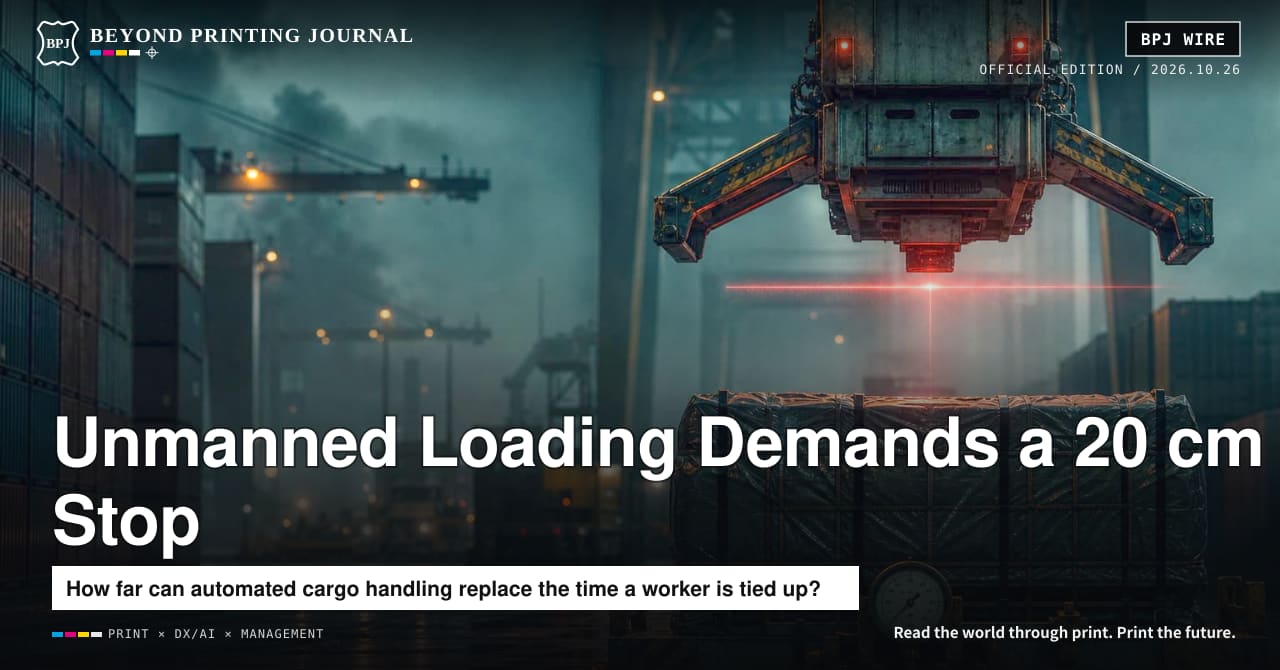
In a workflow designed for fully unmanned operation, the truck must stop within ±200 mm of its designated position. It uses standard pallets that can be forked from all four sides, and avoids cargo protruding beyond the pallet. Positions in the truck bed are also shared in advance, while people are assumed to install and retrieve the wheel chocks.…
Get the weekly digest — free
Enter your email to register free and get a weekly digest of new stories.
The rest is for members
Read the full article. Our feature reports also carry an archive-grade one-page brief (BPJ VISUAL BRIEF) — every figure with its source.
Already a member? Log in
Sources
Beyond Printing Journal — read the world through print, and print the future.