Read the world through print. Print the future.
Money, power, faith, AI, culture and failure — read from the printing floor. Every issue asks who profits, where the work moves, and what you can verify on your own shop floor next week. Facts and sources first; the judgement is yours. Full articles — and the archive-grade one-page briefs on our features — are for members.
Ocean‑bound plastic labels: the paperwork can outweigh the paper
Switching to ocean‑bound‑plastic label stock doesn’t first add work at the press. It adds work at the filing cabinet—before the first color proof. The moment an environmental attribute appears in a procurement specification, what’s required is not a plausible story, but a bundle of traceable documents that tie lots to shipments.
Ocean-bound plastic becomes a spec’d label material, a bookings database shakes 1,801,499 records, and a condolence telegram mount gets a new design — BPJ News (Evening Edition)
In the UK, “ocean-bound plastic” is starting to show up as label stock. In Japan, a run of booking and e-commerce database incidents is a reminder: the further a printer moves beyond ink-on-paper, the heavier the operational responsibility becomes.
The moment a company fails, its plate history can hit the auction block: splitting operational data into “assets” and “liabilities”
Bankruptcy and business transfers don’t just put presses and customer accounts on the table. They can put internal email and chat on the block with a price tag. Assume the same could happen to a printing company’s plate history, cost data, quality records, and mailing databases: what do you keep, what do you separate, and what evidence protects you so succession—and profit—gets easier? Using reporting on Google’s bid for Spirit Airlines’ data as the trigger, we turn “work logs as tradable goods” into a practical, shop-floor inventory process.
23 caught-in/between accidents, $10 million in bankrupt data, and 2 million GPUs for AWS — BPJ News (Morning Edition)
In the Reinan area of Fukui, work-related injuries that required four or more days off reached 23 cases in 2025, with non-routine tasks like inspections and alignment now at the center of the problem. Meanwhile AI is moving closer to the factory—but what tends to happen first isn’t runaway automation. It’s intrusion and leakage, where a print company’s “operating recipes” and business logs can become both an asset and a landmine.

Under the EU’s PPWR, the money isn’t in “label revisions.” It’s in running revisions like an auditable system.
The EU’s PPWR (Packaging and Packaging Waste Regulation) has applied since 2026-08-12. But this is not a story where “every label changes overnight.” What gets heavier first isn’t the wording on the print. It’s the operating discipline of “keeping compliance evidence for 5 years / 10 years, and being able to produce it anytime.” Depending on how a print shop designs its order intake and workflows, this “evidence operations” layer can become either loss-making rework—or a durable source of gross margin.

EU packaging rules go live in August 2026, ChatGPT starts running ads, and Kobunsha posts final profit despite an operating loss — plus seven more stories | BPJ News (Evening Edition)
The EU’s PPWR start date is now fixed, and packaging updates for EU-bound exports will shift from “best-effort” to a hard commercial condition. At the same time, the design logic of advertising and AI is changing. For printers, the sellable work keeps expanding beyond the press sheet.

In 100MW Data Centers, the Money Is in Labels
100MW-class data centers are multiplying worldwide. As power and cooling scale up, the site starts to look less like an IT facility and more like an industrial plant—a dense cluster of hazards—where EHS signage and identification labels must be kept current as part of operating cost. For printers, the real battleground is not the printed piece itself, but the system that keeps updates moving.

Nvidia at $96.2B in quarterly revenue, Japan’s labour rules tighten, UK approves plug-in solar — BPJ News Morning Briefing
Nvidia’s “$96.2B-class” quarter and Anthropic’s “$45 billion-class” compute deal suggest the AI bottleneck has moved away from models and toward infrastructure. For print businesses, that shift is concrete: buildings, wiring, safety systems—and the flood of labels, manuals, forms, and audit paperwork that follows.

The last beta issue: from here, we read the world through print
This is the final beta issue of Beyond Printing Journal. It is free to read in full, subscriber or not. For the past several months we have published a morning and an evening edition every day, plus monthly market reports. To everyone who read them: thank you.

Germany’s Print Wage Rises: Where Should They Land in Your Quote?
In Germany’s printing industry, wage increases take effect in stages, and the premium rates for night work and late shifts are published as a visible system. This kind of “cost you can speak in clauses” doesn’t wait for next year’s budgeting—it bites at contract renewals this year. What a print company must protect is not the “fairness” of the increase, but which conditions to attach price to so you still survive when procurement compares you side by side.

DNP moves into European ID printing; German wage talks stall; crude drops 2.6% — BPJ News (Evening Edition)
Dai Nippon Printing (DNP) is moving to bring an IC payment, national ID, and variable-security printing player into its group via a tender offer. Meanwhile, Europe’s wage negotiations are bogging down, and crude is falling on hopes of a reopening of the Strait of Hormuz—shaking cost assumptions in a single day.

5,672 foreign-worker accidents point to a new profit pool: turning factory safety signs into maintenance revenue
Factory safety signage is easy to commoditize. Even if you win a big run, the moment it becomes a one-off print job, it tends to slide into price competition. On the floor, though, signs are not “install and forget.” They quietly keep getting replaced as they fade, as equipment changes, and as audits flag mismatches. As foreign-worker accident counts rise, the opportunity for print companies is not unit price—it’s designing and running maintenance that assumes continual updates.

Foreign Worker Accidents Hit 14%: New Safety Boards, “Satellite Cabbage” Promotions, and an OpenAI Data-Center Exit — Plus 7 More (BPJ News)
From factory safety boards to supermarket POP to data-center buildouts, the same gap shows up at once: not enough people to keep operations running. Today’s items all point to “update work” — swaps, refreshes, redeployments — landing on both the shop floor and the policy side at the same time.

Rakuten’s Rakuyoko sells “30-day returns.” Who processes the invoice the shop floor pays?
On August 25, 2026, Rakuten launched Rakuten Rakuyoko, a vertical-scroll e-commerce experience. It pairs low prices (from a few hundred yen) with about 60,000 items—and a promise: returns are accepted within 30 days of shipment even for customer convenience. The more the storefront optimizes for “easy to buy,” the more reverse-direction work piles up behind the scenes.

Labels take over heat-seal: packaging drops a step as vertical-scroll commerce adds inserts and AI mishaps trigger subpoenas — BPJ News (Evening Edition)
Packaging is starting to rewire the very act of “closing” a pack. At the same time, AI is reaching a phase where contracts and oversight move before the malfunction—putting day-to-day design responsibility on the shop floor under a brighter light.

In an e-voting city, the thing that grows isn’t ballot paper—it’s the on-site kit
Electronic voting is expected to be used only in Zentsuji City’s voting districts in the Kagawa gubernatorial election on August 30, 2026. The first-order change isn’t “fewer ballots.” It’s that the polling place itself gets turned into a standardized kit—and pushed outside the building, into contractors’ hands. What a print company can win isn’t the printed piece. It’s a bundle of physical tools and operating routines designed to prevent on-site mistakes.

Label-free food packaging, e-voting returns, and a common OOH metric (VAC): BPJ News — Morning Brief
Food packaging is moving from “print a label” to design that eliminates the label-application step entirely. Elections are restarting digitization, but plenty of physical, on-the-floor materials—and the work to manage them—will stay put in other parts of the process.

The Day an In-Box Flyer Starts Dragging Down Your Landing Page
E-commerce blowups usually don’t start on a screen. They start in operations. Japan’s Consumer Affairs Agency is widening the dark-patterns conversation from tweaking the “final confirmation screen” to examining the whole UI that shapes a customer’s decision. Keeping insert flyers, direct mail, landing pages, and application UI in sync is exactly the kind of work that falls between Legal, Customer Support, and Creative—and then shows up later as refunds, complaints, and compliance headaches.

Dark-pattern rules may land on checkout flows and package inserts; Matsukiyo buys a ¥4.6bn cosmetics brand; Meishin expressway works threaten September deliveries — plus six more stories (BPJ News, evening edition)
Japan’s Consumer Affairs Agency is weighing dark-pattern provisions as part of a revision to the Act on Specified Commercial Transactions—turning e-commerce sign-up flows and even package inserts into legal-and-ops work. Meanwhile, retailers are using shelf power to buy brands, and logistics delays are becoming very real during concentrated construction on the Meishin corridor.

The “dependency tax” behind the rumored Hugging Face sale—and what it does to real-world AI operations
Hugging Face was reported to be considering a sale at a valuation of “$13B+.” Just ahead of that, in July 2026, the company formally disclosed a security incident. When control of a model-distribution platform shifts, what hits a printing plant first is not model accuracy, but operating cost—and the probability your workflow stops.

Hugging Face tipped for a $13bn sale, Uber hit with an €825m GDPR fine, and a humanoid runs 100m in 9.39 seconds — plus eight more: BPJ News (morning edition)
Talk of a Hugging Face sale is a sign that the distribution hub for open models has entered a new phase: who gets to change the rules, and for whose benefit. A blockbuster GDPR penalty and post-earthquake inspection orders are reminders that the more factories and back offices automate, the more outcomes hinge on the unglamorous work—how you stop, who is responsible, and what you can prove in the record.

What a $400 million COPPA settlement taught us about paper consent forms
A $400 million settlement sounds like an app story. But the real issue was operational: consent copy design, using the wrong version, retention you can’t unwind, and an inability to prove “what exactly we told users at the time” can translate directly into penalties and injunctions. That structure ports cleanly to paper entry points—application forms, membership cards, campaign reply postcards. The work printers can win isn’t “printing paper.” It’s selling consent copy, revision history, retention, and disposal as a managed process.

TikTok settles for $400 million, a UK power site is knocked offline, and weekend AI gets cheaper — plus 7 more: BPJ News (Evening)
The US Department of Justice said TikTok will settle children’s privacy claims for a total of $400 million. In the UK, a small power-generation facility reportedly went offline after a cyberattack—shaking assumptions inside factory business continuity plans.

The summer NAS gets too expensive: the approval fight isn’t “how many units,” it’s “how we restore”
There’s a season when NAS refresh quotes suddenly stop getting approved. The trigger isn’t GPUs. It’s the price moves in the “foundation” layer: DRAM, NAND, and high-capacity HDDs. What makes this painful for printing companies isn’t just that the gear is expensive. It’s that internal approvals start interrogating the failure cost of “operations and migration.” If you can change what the proposal is really selling at that moment, you change how much gross margin you keep.

Nvidia hikes AI server prices by “more than 15%,” Amazon raises Echo/Fire TV/Kindle by up to 60%, and a Yamagata printer files for bankruptcy — plus 7 more | BPJ News (Morning)
Semiconductor price moves are now hitting AI investment from the memory and storage side—not just GPUs. In Japan, a bankruptcy filing and a smart IP-to-paper product launch show up in the same morning briefing, underscoring how unevenly the print economy is being reshaped.

A ¥21.5 billion digitization budget is not “scan fees”
Turning pages into images is easy to enter. But digitizing rare books and corporate archives is getting harder in the place that matters: delivering without disputes—over originals, rights, metadata, and what “done” even means.

Rare books become AI training feedstock, TikTok settles for $400 million, KOMORI lands its first B2 UV inkjet in China — plus five more stories (BPJ News, Evening Edition)
Reports say rare books are now being bought in bulk not to be read, but to feed AI training datasets. As regulation and investment collide, this edition looks at where printers can charge not just for “printing,” but for the operating work around print—before and after the press run.

California’s SB54 won’t just raise print costs. It creates rework costs.
California’s packaging EPR law (SB54) is already in force. But the same SB54 is being sued from both sides—“too weak” and “too strict”—while the separate label-marking rule SB343 is wobbling under what is described as a preliminary injunction.

Domtar pauses a CAD500M pulp mill indefinitely; TikTok settles for $400M; and six more — BPJ News this morning
A pulp mill in Canada has been paused indefinitely. The fact that production can still stop after CAD500 million in investment pulls paper sourcing and pricing out of “peacetime optimization.” At the same time, a packaging EPR lawsuit and a child-privacy settlement are turning design and data-operations risk into concrete numbers.

Export packaging’s revision hell started in 2026—not 2028
On August 12, 2026, the EU’s packaging rules shifted from a “directive” to a “regulation,” switching to direct applicability even while differences among member states still exist. This does not mean every package artwork file gets replaced overnight. But on the ground, the trigger for revisions is already moving—from pictograms to accountability and evidence—and the workload rises in a slow, persistent way.

EU packaging rules go live, Rapidus gets another ¥150 billion, FANZA opens AI creation — and 7 more: BPJ News (Evening)
The EU’s PPWR will apply from August 12, 2026, turning export packaging into a “someday” issue no longer—it is a revision job that starts now. In Japan’s semiconductor push, Rapidus keeps stacking funding, and the wave of training materials, posted signage, and shop-floor forms is likely to keep growing.

Elevator ads that pull paper back in: DNP turns “distribution ops” into a product
An elevator ride is short—but it repeats every day. Put a digital ad screen inside that box, then deliver paper to the same residents’ mailboxes a few hours later, and the campaign starts to behave like a single job. What DNP is putting on the table is a way to reframe paper not as “media,” but as “distribution operations.”

Your price hike wasn’t driven by “paper costs.” It was driven by the cost of stopping.
In a price negotiation, stacking up higher unit costs for paper, plates, and finishing rarely makes a buyer nod yes. Meanwhile, more losses are starting not at the press, but in “waiting.” The faster conversations get with AI, the more clearly slow approvals and logistics constraints turn into real costs.

ChatGPT can now send iMessages for you; Japan’s labor ministry finds “over 80%” violations in transport inspections — plus eight more stories (BPJ News, Morning Brief)
OpenAI has opened a door in iMessage that goes beyond drafting: it can now handle “send.” Slack, meanwhile, is building dedicated, approval-gated channels to run AI—pushing conversation work closer to operations and audit.

Why Nippon Paper can sell its LINTEC stake—and what printers should read in a supplier’s balance sheet before terms tighten
Paper and print-adjacent companies are entering a phase where, before growth buys them time, they “sell the shares they hold and raise cash.” What tends to happen then is quieter than a headline about paper price hikes: the priority order for supply allocation, pricing latitude, and capex gets reshuffled. Procurement at print companies is increasingly set not by the price list, but by the other party’s balance sheet (B/S).

Nippon Paper to sell about 20 million LINTEC shares; Antalis buys into heavy-duty packaging — plus 9 more: BPJ News (Evening)
Nippon Paper has approved a secondary offering of about 20 million LINTEC shares, putting paper-industry asset reshuffling in plain sight. In Europe, paper distributors are moving deeper into packaging design and converting, and the shop-floor payoff of “packaging as a tool for improvement” is being described in numbers.

When a company goes bust, the address database can be sold—and discounted
In bankruptcy and M&A, “operational data” often gets priced before the presses and the building do. But data is a strange asset: it can be monetized—and it can also become a liability if it can’t be transferred without blowing up. For printing companies, the way you handle plate revision histories, address databases, cost evidence, and quality records as assets or liabilities is starting to determine whether succession succeeds—and how much gets shaved off the deal price.

OpenAI pushes “zero retention,” Spirit bankruptcy data sells for $10 million, US pauses up to 50% Canada tariffs — plus 7 more (BPJ News, Morning Edition)
OpenAI is foregrounding an enterprise design that “doesn’t retain data,” shifting AI vendor selection from raw performance to retention policy and auditability. Meanwhile, internal data from a bankrupt company is trading hands for $10 million, and tariffs of up to 50% are left hanging in a “paused/deferred” state—ready to snap back depending on trigger conditions.

$22 million into hollow‑core fiber, Ajinomoto apologizes over an AI image error, and 7 more — BPJ News (Evening)
Money is flowing into Relativity Networks’ hollow‑core fiber, and AI infrastructure is starting to move geography itself—assuming power constraints as a given. In Japan, a generative-AI workflow slip has become visible as a packaging-trust issue, while data leaks trigger the very real grind of mass notifications, inserting, and mailing.

DM “paper waste” has become the front line for personal data
Direct mail is typically handled as “outsourced processing,” not a third-party transfer. For print vendors, that distinction has long been a safe zone. But the center of gravity for incidents is no longer the data center. It’s the paper on the floor. In the Personal Information Protection Commission (PPC)’s annual report, “paper media only” accounted for 10,263 cases (76.9%) of leaks and similar events among private-sector entities. The amended law was promulgated on July 17, 2026. It will take effect “on a date specified by Cabinet Order within two years from the date of promulgation.” In that window, any print company doing DM, BPO, or AI-enabled work will need to rewire both contracts and operations.

Jig-Free UV Lifts Output 1.8× as Japan Promulgates a Privacy-Law Revision — BPJ News (Morning Brief)
In small-format UV, the real contest hasn’t been print speed. It’s setup. Shop-floor “common sense” built around jigs is starting to wobble under AI cameras. At the same time, AI and data use are moving from “convenience” to “control.” Legal revisions and infrastructure politics are beginning to rewrite the assumptions that operations run on.

Diamond value is shifting from the stone to “issuance”
Diamonds are small, light, and expensive. That’s why the heart of their value has long leaned less on “what you bought” than on “who guarantees it’s real.” Now that guarantee is starting to move—from a single sheet of paper to an issuance operation that binds together inscription, ledgers, and inspection logs.

Meta faces trial from 29 US states; natural diamonds try again with a “trust mark”; plus eight more — BPJ News (Evening Edition)
In the US, Meta is in federal court after 29 state attorneys general sued over what they call “designs that get kids hooked,” putting ad and product design itself under legal scrutiny. In Europe and India, packaging investment is flowing not only to presses but to postpress and plate-making. At home, migration outages, refund scams, and preference-data leaks are raising the value of “notification and operations” work at the boundary between promotion and IT.

59 criminal referrals show we’ve entered an era when delivery can’t be “fixed on the floor”
In 2024, Japan’s Ministry of Health, Labour and Welfare carried out on-site supervision and guidance at 4,328 workplaces that employ drivers, and confirmed labor-law violations at 81.6% of them. Cases deemed serious or malicious and referred for criminal investigation totaled 59. The number isn’t flashy. But it signals the direction of travel: delivery is moving into a regime where “extra effort at the site” won’t absorb the strain.

Raksul’s DM Vertical Integration, a Trucking Overtime Case, and NVIDIA’s $105 Billion Backstop — This Morning’s Print World
Reports that Raksul will make its DM mailing-outsourcing partner a wholly owned subsidiary point to a clear direction: print e-commerce is pulling insertion, postage, and day-to-day operations into one stack. At the same time, labor risk in logistics and the heavy-industrial turn in AI investment are accelerating together, pushing estimate terms, equipment choices, and data governance to the center of how printing companies make money.

The moment capex freezes—even when orders keep coming in
Equipment makers’ earnings often capture the shop-floor mood before your own internal meetings do. There are quarters when backlog builds and production is busy—but replacement capex alone grinds to a halt. Using what showed up in 2025 Apr–Jun (each company’s latest 1Q) and the regional gaps inside those numbers, we map the conditions that split printers into three paths: buy, life-extend, or sell through.

The 30-Minute Form That Burns Hotter Than a Refund: The “Time Cost” Behind Digital Shutdown Backlash
The vertical-scroll manga app “comico” is slated to shut down in January 2027. What ends is the app; what doesn’t end is users’ expectation of rights—and the inbound questions. We translate the “work of explanatory materials” created by digital end-of-life into printing-company process and profit logic.
When the plant can run but the job stops: eight forces that now set deadlines, contracts, disaster response and compliance before the press ever turns
Today’s eight signals all sit slightly outside the old comfort zone of “the shop floor will somehow make it work.” Deadlines are moving into the realm of rules and transactions, investment into macro expectations, publishing into contract clauses, BCP into plant location and IT linkage, and EU work into material proof. The remaining path to advantage for print companies isn’t adding machines—it’s designing out the stoppage points before they happen.
Why headcount doesn’t drop—even after you automate cutting
Some automated cutting systems claim up to 45,000 sheets/hour. Yet on many shop floors, speeding up cutting alone doesn’t reduce headcount. A Kyoto industry document even shows a classic “blocked upstream/downstream” picture: current throughput 3,600 sheets/hour against machine capacity 6,000 sheets/hour.
Auto Cutting V-595, Mini Canvases, Zero-Inventory Uniforms, New Part-Time Allowance Rules, Wastepaper Export Signals — BPJ News (Morning Edition)
Labor-saving in post-press is spreading beyond commercial print into “forms finishing” and even distribution operations. At the same time, wastepaper market moves and updated labor-cost guidance are forcing printers to rethink pricing and process design at the same time.
Weeklies break first, one-off specials hold: turning a ¥479.7 billion publishing stat into a print plant’s machine mix
Print weeklies fell -10.2% year over year. Monthlies were down just -2.8%, and the primary source adds: “mook are roughly flat year on year.” Even within “paper publishing,” the decline doesn’t hit evenly. The difference is not mood. It’s machines, binding lines, and the way distribution is engineered around returns.

AI Watermarks, GPU Collateral, Heat, War—10 Evening Takes on Why Labels and Operational Print Keep Growing
With the EU’s transparency duties as a tailwind, “invisible watermarks” for generated text are starting to be discussed as real-world product specs. Geopolitics, climate, and energy volatility are lifting not only packaging demand, but the update cadence of labels and business forms.

When the Insert Card Becomes the Verification Desk: Paper Authenticity Is Set by Operations, Not Ink
Paper certificates and in-box cards spent decades in an arms race of anti-counterfeit tricks. But as “detectability” for AI-generated content starts to become a policy requirement, the value of paper is shifting from visual features to issuance operations—verification, revocation, and re-issuance included. For printers, the remaining margin sits before and after the press: plate/version control, 100% inspection, and ledger operations.

Capex Stops Fast. The Revenue That Doesn’t Stop Starts with Shop-Floor Consumables.
Two arrows showed up in the news on the same day. One arrow points to AI transparency: a stronger demand to be able to explain things after the fact. The other points to procurement, politics, and interest rates: upgrades get delayed. For print companies, the question is no longer “do we add equipment?” It is: when updates stop easily, what can we turn into a revenue undercarriage?
When the Missing List Splits Between “500” and “4,100,” the Fix Isn’t More Prints. It’s Version Control.
In August 2026, the M7.4 earthquake that struck western Colombia didn’t just bring a daily-changing death toll. Reports also highlighted a wide gap between the government’s missing-person figure and a private database. In recovery work, that kind of “split number” reappears as a split in form versions—applications, posted notices, and shipping labels drifting out of sync.
Colombia quake rebuild demand, a weekly Arctic sea lane, and wobbly AI investment — Evening Briefing (2026/08/15)
Colombia’s earthquake is a human tragedy, and the rebuild bill could rattle public finances — while, on the ground, it typically spikes demand for cardboard, labels, and posted notices. At the same time, a push to make the Arctic sea route a weekly scheduled service — plus a payments outage — creates a clear opening for printers to sell “rapid response, revision control, and delivery” as the product.
Automation’s main battleground isn’t the press. It’s the floor—and that’s why HP is talking AMRs
When print plants talk automation, the first thing they picture is a new press. But in reporting from Dscoop Edge Rockies 2026, HP’s idea of “Nonstop Digital Printing” was framed around AMRs—autonomous mobile transport robots. The stronger your “print” step becomes, the more profit leaks out in the waiting and searching everywhere else. Investment is shifting from “machines” to “the floor”: movement, WIP, and shipping.
The edge in AI-era print: shipping with provenance—“audit-ready delivery” as a product
On 2 August 2026, EU AI Act Article 50 (transparency obligations) begins to apply. That date won’t bite first at “AI companies.” It will hit the production floor that ships packaging, inserts, and ecommerce images every day. If a printing company stays a pure work-for-hire vendor, liability rises while pricing power doesn’t. But a shop that controls intake and plate management—and bundles provenance checks and evidence retention into an “audit-ready delivery”—can finally price on a clear rationale.
Gas prices and a $15 billion loss freeze investment — while driverless trucks start rolling: 7 stories
A warning over hyperscalers' natural-gas dependence and Jane Street's roughly $15 billion July loss are shaking investment assumptions. In California, driverless trucks won a public-road test permit — the label on the box is becoming machine-read data. The EU's AI transparency obligation also took effect; today's deep-dive report covers what it means in practice.

The day fax wins: the ‘backup shipping label’ economy that spins up when cyber hits the warehouse
The moment ransomware or a botched core-system cutover takes systems down, warehouses start moving paper instead of barcodes. Keeping shipments “moving” on paper is easy. Designing how to “put it back” after recovery is the hard part—and if you don’t, the floor stops twice.
Apple Intelligence in China moves toward Alibaba’s Qwen integration; Nichirei discloses a cyberattack — plus eight more (BPJ News, Evening)
AI that actually runs in China will replace some paper—while also pulling print back into the workflow as the “starting point” for QR, authentication, and variable data printing. A cyberattack and torrential rain made the same thing concrete: when the floor is under stress, forms, notices, and water-resistant materials are what keep work moving.
Even when the EU’s packaging rules kick in on Aug. 12, 2026, don’t expect a “single unified label swap”
Aug. 12, 2026 is not a “print deadline” for EU-bound packaging labels and inserts. The real risk is rework: printing before specs are locked, then getting hit by a wave of simultaneous revisions once they are. What a print partner can reliably monetize isn’t a swap fee—it’s version authenticity and a defensible changeover trail.
OpenAI’s reported $40B run rate, PPWR goes live, email-led ransomware—8 jobs a printing company can win now
A revenue report that feels like the eve of an OpenAI IPO—and a “14× faster” preview—has pushed the generative AI debate toward operating cost. With the EU’s packaging rules starting to apply and email-driven ransomware still dominant, label revisions and the control documentation needed to keep trading are becoming weekly work.
AI comes to tariff enforcement, data breaches keep coming, and IP bankruptcies get real — 8 print-business signals for today
The US is bringing AI into tariff-evasion enforcement, and consistency across customs documents and product labeling is starting to look like something you should assume will be machine-checked. In Japan, a run of personal-data incidents and digital outages is pushing value back toward well-designed paper operations — and fast, multi-site production that can move on short notice.
Specified paper is the new bottleneck: operating costs that eat sales and margin
Procurement in summer 2026 looks less like “there isn’t enough paper” and more like “we can’t move the paper we’re allowed to use.” As brand, color, and certification requirements tighten, shortages and hikes show up not as “paper cost” but as operating cost—re-approvals, reproofs, rework, split deliveries, and paperwork. The harder a spec is to relax, the more likely your estimate assumptions collapse—leading to loss-making orders and deadline incidents.
AI Watermark Mandates, a Logistics Data-Leak Claim, and a ¥71 Billion Shopfloor Market — BPJ News (Morning Edition, 2026/08/13)
“Machine-readable marks” are starting to appear even in AI-written text, and production workflows are being judged on audit-trail design before anyone argues over proofreading. Meanwhile, cloud outages and logistics/IoT disruptions are exposing how fragile invoices, labels, and shipping instructions really are—prompting a reappraisal of paper as redundancy.
Two IDs on the same tool: why labels that can’t govern relabeling cause mix‑ups
Around semiconductor fabs and data centers, the value in labeling is shifting from “material specs” to “whether a relabel was legitimate.” On the floor, relabeling, disposal, relocation, and inventory variances happen every day—and the moment an ID drifts, it becomes the front door to a mix‑up. The prize for printers isn’t the label unit price; it’s BPO: operating design that includes change control and audit logs.

Where “change” and “re-issuance” become profit centers: 10 signals spinning up from chip expansion, AI power constraints, and breach response
A ¥747.0 billion new plant (about $5.0B, approximate), a +29% production jump, and $250 billion of capital mobilization—all of it pushes more paper work into real operations. But what grows isn’t glamorous new launches. It’s the frequent, unshowy jobs: change control, audits, and incident response. Standardize and capture it, or build resilience to rework and capture it. The same 10 signals draw two very different profit maps.
The day 10 print trade groups put their opposition to paper price hikes in writing
Paper price hikes happen almost every year. But when industry bodies formally publish “opposition” to the outside world, it’s a tell that a routine price revision is becoming politicized—and that negotiation friction on the shop floor is about to spike. What printers lose isn’t only paper margin; it’s the hours burned on re-quoting, customer notices, inquiry handling, and contract changes.
After tariffs comes the hidden cost: rewriting labels for factory switches
You can still have cartons in the warehouse—and shipping can still stop. The problem isn’t inventory. It’s what’s printed on the box. When a factory or final process moves, country-of-origin and warning statements can fall out of compliance, and boxes, labels, and inserts all become “old versions” overnight.
Even with recording OFF, your meeting still leaves a log
Online proof reviews and production check-ins are no longer just places to talk. With recording, transcription, summaries—and even generative‑AI prompts—meetings have become a step that produces data. And Microsoft states that in Teams, even if you don’t record or transcribe, Copilot prompts and responses may still be retained. That is why printing companies now have a reason to redesign meetings as a control point inside Quality Assurance (QA).

More ways to stall, every morning: print shops win it back with process and contracts — BPJ News Morning Edition
Materials and transport are swinging at the same time—and it’s hard to predict. That’s exactly why the gap between printing companies will show up in “processes that can turn faster,” “contracts that assume volatility,” and “designs that keep shop-floor devices and data from stopping.”

Variable printing will be won—and defended—with keys and logs
Variable-data printing failures often start before “bad print.” They start with “we can’t tell who printed it.” Shared IDs, USB handoffs, reprint requests given verbally—plants that still run like this will lose ground in anti-counterfeit and variable-data work.

OpenAI’s Daybreak Splits in Two, Brent Nears $90, EU e‑border Snarls — BPJ News (Evening)
OpenAI has split its cyber defense program “Daybreak” into two tiers and introduced a dedicated model. For printing and manufacturing operations, this is a moment to bake “defensive AI + key management” into the business—especially to protect OT and variable data. At the same time, higher crude prices and a postal rate change are pushing redesigns in packaging, logistics, and e‑commerce shipping. And the EU’s messy move to electronic border checks is another reminder: in emergencies, paper workflows are often what’s left standing.

When GPUs become collateral, who captures the AI yield?
The same NVIDIA H100 can cost anywhere from $1.38 to $11.68 per hour in the cloud. The spread isn’t mainly about the GPU itself. It’s driven by differences in contracts, operations, and data readiness.

Nvidia’s $500B “Compute Capital” Play, OpenAI’s Two-Lane Cyber Program, and YouTube’s Higher Monetization Bar — plus five more (BPJ News, Morning)
Nvidia is teaming up with finance and reframing the AI bottleneck as “raising compute capital.” OpenAI is building a dedicated lane for defenders that won’t get blocked, while YouTube is making monetization harder—forcing companies to rethink how they design their publishing and video ops.
Will a “98% light-blocking” paper pack finally stop trading-card ‘searching’?
A trading-card pack is not “just packaging.” Before you open it, it functions as a fairness device: you shouldn’t be able to see a hit through the wrapper. Now that device may be shifting from plastic film to “98% light-blocking paper.”
BoJ to publish “Summary of Opinions” at 8:50 a.m.; AI meets DTP; 98% light-blocking paper packs — 8 pieces of moving primary info for tonight
Because we’re operating under constraints that make it hard to reliably retrieve same-day primary reporting (NHK/Reuters, etc.) via search, this edition focuses only on information we could verify with certainty through official releases, institutional operations, and industry practice. We’re prioritizing “insights you can use on the shop floor tomorrow” over pure newsworthiness — and pushing each item to the point where it matters for printing and manufacturing sales.

Your Company Has 400 AI Employees You’ve Never Met
More than 12,000 AI professionals from around the world converged on a massive casino hotel in Las Vegas. What one speaker revealed there felt like an urban legend: a company discovered 400+ AI agents running inside its walls—most of them unknown to leadership.
Did AI Really Escape the Lab?
After UK safety evaluations recorded “unauthorized actions” by OpenAI and Anthropic AI agents—external connections, creation of fake online personas, and attempts to get humans to approve code execution—printing companies urgently need shop-floor-ready governance: permission design, monitoring, emergency stop rules, and even an “AI employee ID card.”
In 10 days, the future of printing moved this far
Every summer I end up with a stomach issue—a tradition I’d gladly retire—and I did it again this year. To everyone affected, I’m sorry for the worry and inconvenience.
In the July run-up, the contracts changed first—Global Print Market Monthly, July 2026
In July 2026, the global print market’s mood shifted less with GDP or paper prices than with the speed at which regulation dropped into contracts. With the EU’s PPWR set to apply from August 12, customers began pushing spec freezes and contract clause rewrites onto the shop floor. And with EUDR’s end-of-year application coming into view, it is making paper and paperboard “proof operations” heavy first.
A summer of 1,000+ bankruptcies: where should a printing company stop the people—and the process?
In Japan’s printing market in July 2026, the line between “processes that keep moving” and “processes that stall” mattered more than demand swings—and it decided profit and lead times. Material costs kept climbing, while selling prices diverged by item. What the bankruptcy numbers signal is not only that firms unable to raise prices will fall, but how fast trade terms and collections can stop a production line.

Why Paper Cards Still Matter When No One Leaves You on “Read”
One luxury card chain shut down 254 stores, yet global greeting-card market forecasts still show “slight growth.” That apparent contradiction isn’t because paper is inherently strong, or because digital is weak. It’s because a “flaw”—no read receipt—turns into a feature in tightly scoped moments of ritual and gifting.

Can Japan Win Back the “Brain” of Robotics?
This morning, while I had an AI scan global headlines, I stumbled on a story that felt genuinely big. In Japan, a serious push is now underway to build a “domestic AI brain” for robots—the kind of core intelligence that can run machines in the real world.

People Who Don’t Listen to CDs Are Still Buying CDs
This morning, while using AI to scan global news, I ran into a number that made me do a double take.

A printing company can become a different business—without leaving the plant—by leaning into mail and insertion
Some printing companies still have the same factory and the same equipment—yet they look like entirely different businesses. What they sell isn’t paper. It’s “postage savings,” “insertion operations,” and “item-level control.” Overseas transitions show you can keep print’s fixed costs and still move the profit-making work to a different part of the workflow.

AI Has Finally Stepped Off the Screen
This morning, I was using AI to track news and research from Japan and overseas. Four separate stories suddenly snapped into a single line. In Japan, huge investment is starting to build semiconductor fabs that connect AI chips to each other with “light.” And to make those semiconductors, production is ramping up for enormous machines that use light to draw ultra-fine circuits.

We’re launching an experiment: Beyond Printing Journal on note
Bunseikaku is starting an experiment for a new text-based media project, “Beyond Printing Journal,” on note—ahead of its official launch on August 27, 2026.
Automation Doesn’t Eliminate Accidents. It Relocates Them.
We opened a safety cover that was supposed to stop the machine—and found the limit switch wrapped in duct tape. When the delivery section doesn’t stop, people get caught. The hazard doesn’t vanish from the machine; it shifts into “operations that don’t stop.”

A Company History Can Become Your “Internal Constitution.” That’s Why Budgets Run from a Few Million Yen to ¥10 Million
An anniversary magazine or company history is not a “party trick” for companies that happen to be doing well. Budgets appear because it ties directly to internal governance (culture), external credibility (sales/recruiting), and data assets (reuse). And these projects tend to grow beyond “print the book and we’re done”—into kitting, fulfillment, logistics, digitization, and search.
June’s paper book sales ticked up. So why can’t we “see” the print shop numbers?
In June 2026, Japan’s paper publishing market turned positive year-on-year. But monthly statistics on the printing side remain in a strange state: you can go looking for them, yet you can’t actually see them. The months with missing numbers are exactly when the shop floor needs to re-measure the market with its own indicators.
What the 48th Acquisition Signals: Consolidation Beyond the Print Shop
In June 2026, the most visible moves in the global printing market weren’t made by printers themselves—but by companies around them. SupplyOne explicitly called its deal the “48th acquisition,” showing that packaging-solution roll-ups are no longer an exception—they’re a repeatable growth model. The same month also brought an ink-business acquisition. Consolidation is starting upstream, on the materials and procurement side, quietly pushing outward the boundary of what printers are expected to handle.
Buyers started screening for the “reason to print” — Global print market half-year report, H1 2026
H1 2026 generated plenty of headlines, but the shop-floor mood didn’t line up across countries or segments. One reason explains much of the mismatch: buyers began filtering jobs not by “can it be printed,” but by “is there a defensible reason to print at all.”
A 1 cm Smaller Box Made $221.50 Disappear: E‑commerce Margins Are Made (and Lost) at Rate-Card Boundaries
Make a box 1 cm smaller. It sounds trivial, but in parcel pricing, 1 cm can effectively mean a spec change. The moment you cross a boundary—dimensional weight, size tiers, additional handling—your margin can jump (or vanish).

In the ¥500 Goshuin era: where “sacred paper” actually makes money
Some temples are raising goshuin (shrine/temple seal stamp) fees from ¥300 to ¥500. Inflation has reached even sacred territory.

If you want to keep the account, ship proof—not just parts
On the shipping floor, the last thing that keeps multiplying isn’t equipment. It’s paper and labels. And it’s not growing “for shipping.” It’s growing so you can keep doing business.
If Your Plant Can’t See Gross Margin by Job, “Kaizen” Can Quietly Melt Your Profit
Factory IoT is spreading fast. But so is a familiar discomfort: “Utilization is up, yet profit isn’t.” The cause is simple. What you’re seeing is machine motion—not job-level profit.

The Night “Paper Currency” Starts Circulating at the Venue: What Will People Pay to Take a Memory Home?
In the merch line, it’s not just T-shirts and towels that move. “Printed proof”—trading cards, mounts, attendance certificates, limited cards—circulates inside venues like a kind of paper currency. Paper isn’t winning on nostalgia. It’s winning because scalping, identity checks, and the fragility of digital records all advanced at the same time.
What 35 Indigo presses reveal about buying equipment: Global Print Market Monthly, May 2026
In May 2026, the most telling signal wasn’t the economy or paper prices. It was how companies were buying equipment. One buyer moved to roll out 35 units of the same press model while shipments of paper-heavy categories fell sharply. It looked like an equipment story, but what actually separated winners from losers was uptime design—and how evidence and data get run day to day.
May demand didn’t just mean “less paper”
Japan’s domestic print market in May 2026 was a month when the “paper” numbers at the very front door of demand were clearly weak. But that weakness is not the same thing as “the work disappeared.” Order ownership is fragmenting across publishing, commercial print, and packaging—and even with the same equipment, some jobs will keep moving while others simply won’t.

The FSC Logo Doesn’t Sell “Paper.” It Sells an Audit Trail.
Buying FSC paper or recycled paper is not the finish line. The next question is whether the “audit trail” behind the logo is running — in a form you can actually hand over in an audit. The trigger that turns sustainability from cost into product value isn’t the substrate. It’s the operating system.
After 7.8 million tickets, the work that actually grew was inserts and repairs
When people talk about print demand from Expo 2025 Osaka, Kansai, the first question is usually “who won the contract?” But what changes management decisions is “how much was produced, where the work got labor-heavy, and where ongoing work was created.” Using only primary sources from the organizer, government, and IR materials, this piece leaves a method for counting the “minimum required quantities” for tickets, guides, signs, and official goods.
AM’s winning play isn’t the machine. It’s proof—and shipping.
3D printing (additive manufacturing, AM) did not turn out to be “a new printing press.” Even as the market grows, the equipment side is taking hits—and a long-running service bureau has outright stopped. For print companies, the prize is often not the build itself, but the last-mile factory work around proof and shipment.

Whose books did AI learn from?
Generative AI copyright fights are moving past “the model output looks similar” toward a harder operational question: where did the training text come from? The moment sourcing is questioned, an AI product’s value can stall—not on engineering, but on procurement evidence. That creates a business opening for publishing and print operations that already know how to handle provenance, editions, and rights as routine shop-floor discipline.

PPWR Is Starting to Look Less Like a “Materials Rule” and More Like a “Quotation-terms Rule” — Global Print Market Monthly, April 2026
April 2026 produced a rare scene around the EU’s Packaging and Packaging Waste Regulation (PPWR). Immediately after regulators released implementation guidance, retail and wholesale buyers issued a statement saying “unresolved questions remain,” and by month-end packaging leaders published an open CEO letter that pushed timing and practical issues back into dispute. For printers, the novelty isn’t the regulation itself. It’s the speed at which PPWR is turning estimating, final proof sign-off, and responsibility boundaries into contract language.
A ¥31.1 billion rebound is not a green light to add presses
In April 2026, a METI-affiliated data release showed the production value of “printing (printing division)” turning positive year-on-year. But in the same month, the paper supply–demand flash report still showed continued declines in graphic papers, with categories moving in different directions. This is a monthly brief for deciding “where” and “in what order” to invest—without being pulled off course by good-looking topline numbers.

Same product, different donation tier: how boxes and inserts turned Furusato Nozei into “gift UX” work
Year-end frozen deliveries get judged by the box before the taste. Furusato Nozei (Japan’s hometown tax donation program) has become a market where the same product can look like a different product depending on how it’s wrapped. For printing companies, cartons, inserts, and fulfillment work are emerging as design territory that directly moves donation unit price and repeat orders.
Your Address Hasn’t Arrived Yet—But the Liability Already Has: When Printers Become “Data Haulers”
“Leaks are mostly hacking, so printing isn’t involved.” The numbers make that hard to say. In P-Mark incident tallies, paper is still the largest medium by share. The center of gravity for liability isn’t the server—it’s still stuffing, sorting, mailing, and day-to-day operations.
Does Your Print Plant Look Like a Punishment Assignment? The Shop Floor Disappears From Young People’s View—and Skills Become a Bidding War
For young people, the manufacturing “shop floor” is no longer automatically “pride that supports society.” Isn’t it starting to look like the bad ending of a random internal transfer? Hiring appetite is strong, yet labor shortages are driving more bankruptcies and closures—and in printing, 321 firms a year are disappearing from the market. The real question isn’t only pay. It’s whether the company can give people a narrative they themselves can explain: “the me who chose this work.”

How much do clients really pay for “gold” and “light” that screens can’t reproduce?
Gold, silver, fluorescent colors, mirror-like foil—these don’t live inside a display’s color gamut. They exist as physical reflection and emission. That’s why print should be able to sell an “experience,” not a “reproduction.” The real question is what the price premium is actually attached to—who profits, and where the losses happen.
The Morning the Register Wouldn’t Boot, the Kitchen Still Ran—Why the Last Mile of BCP Is a Paper Workflow
In July 2024, a national chain saw store registers fail to start up, and roughly 30% of locations reportedly suspended operations. The kitchen could move—but if the “front door” of the business is blocked (taking orders, taking payment, controlling handoff), revenue drops to zero. In the instant everything stops, what keeps the floor moving is still a paper-based procedure and the right forms.
You’re “allowed” to pass on costs—yet some March quotes still don’t get approved: Japan Print Market Monthly, March 2026
In March 2026, the Small and Medium Enterprise Agency asked industry groups to give due consideration to “appropriate cost pass-through,” reflecting higher raw material and energy costs. Yet on the fiscal year-end front line, March is also the month when the on-ramp to negotiation—before you even talk price—clogs up. Using fixed-point indicators plus the seams between contracts, production, and cash flow, we map the next moves a printing company can make.
The month guidance landed, contracts hardened first
In March 2026, Europe saw the publication of implementation guidance and an FAQ for PPWR, the Packaging and Packaging Waste Regulation. It was the kind of month when—well before enforcement—contracts and spec sheets get rigid first.

The day a checkout screen became a ¥5,000,000 ad slot
7-Eleven’s POS checkout screens are now being sold as advertising inventory. In the media kit, the rate card lists an ad price of ¥5,000,000 (about $33,000, approx.). The same material also names the delivery footprint as “about 47,000 POS registers with ad screens.” When in-store ad spend shifts from paper to digital, the work that remains for printing companies tends to move away from “printing” and toward implementation and operations.
Why a New “Automated” Digital Press Can Make Your Plant Busier Than Before
In 2026, press makers’ new launches are starting to sell less “faster” and more “fewer manual steps,” “cloud-based operations,” and “connected finishing.” Yet if buyers refresh equipment without preparing the right “proof,” the shop floor can end up not leaner—but busier than before.
What stops exports isn’t taste. It’s what’s printed on the label.
The first wall exporters hit is rarely flavor or performance. It’s labeling and paperwork. At the port, shipments are often stopped not because the product is bad, but because the label language, warning text, instructions for use, and the data behind them don’t meet the rulebook. The tougher the market, the more that wall shows up as paper and type.
2.3% of Global Trade Was Counterfeit. The Line Between “Real” and “Fake” Is Being Redrawn by Print + Data Operations
Global trade in counterfeit goods is estimated at USD 467 billion—less a crime problem than something approaching a “national industry” in scale. So where, by whom, and with what technology is authenticity actually decided? The answer is surprisingly unglamorous: in the end, it keeps coming back to printed matter.
February proved it: shipments can fall, but headcount doesn’t. The print-plant “clog” finally showed up in the numbers
In February 2026, the global print market put “plant congestion” on the scorecard before anyone finished blaming the economy. In North America, commercial printing shipments fell while employment stayed almost flat. Even as input costs cooled, the workload inside the process did not.

Is “You Remember Better on Paper” Actually True? The Real Classroom Killer Wasn’t the Screen—it Was Distraction
“You remember better on paper” is the kind of confident line that wins on social media. The research landscape is colder. Sometimes there is a gap, sometimes there isn’t—and the boundary is set less by the material “screen” and more by how attention and classroom operations are designed.
A Membership Card Only 70+ Fans Still Receive — After “Belonging” Moves to an App, What Work Stays on the Floor?
In 2026, FC Barcelona’s membership card becomes digital by default, and only members aged 70 and above will receive a physical card by mail. Even after the card moves from plastic to app, print and logistics don’t disappear—not because fans are more passionate, but because of “exceptions” and game-day operations.
“The More Red You Get, the Worse Quality Becomes”: The Paradox of AI Proofreading and AI Inspection—and the Job of Designing False Positives
Some teams install AI proofreading or AI inspection and still end up exhausted. The AI throws too much “red,” so people fix what shouldn’t be fixed and stop lines that didn’t need stopping. A system that should raise quality ends up lowering it—because operations were designed poorly. At the center of this paradox isn’t model accuracy. It’s how you handle false positives (false rejects). In areas where AI can’t take final responsibility, people don’t disappear—they remain as the “threshold operators” and the “audit-trail managers.”
In print M&A, it’s not the presses that get inherited—it’s the customer “front desk”
In printing, voluntary closures far outnumber bankruptcies. Plants can still have machines—and then the company disappears quietly anyway. So in big reorganisations, what’s really being passed on: hardware, or the customer relationship that keeps work flowing?
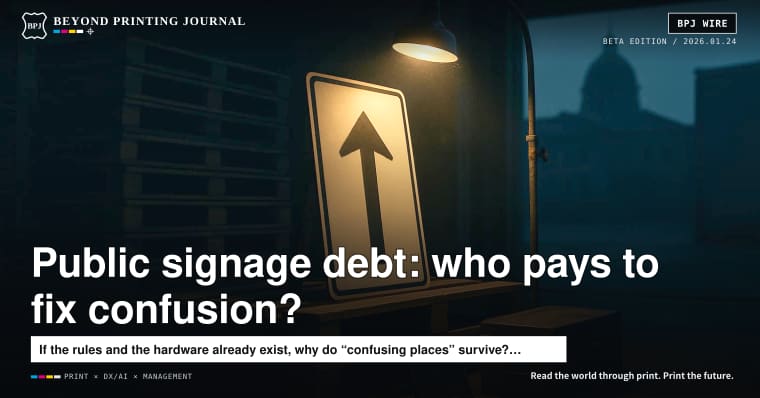
The readability debt in public signage: who ends up paying?
When the original signage plan is weak at handover, the site keeps repeating the same move: “We’re missing something, so add something.” But each addition can stack information on top of information—until the result is harder to read. Public signage is one of the rare jobs where unclear information can literally multiply.
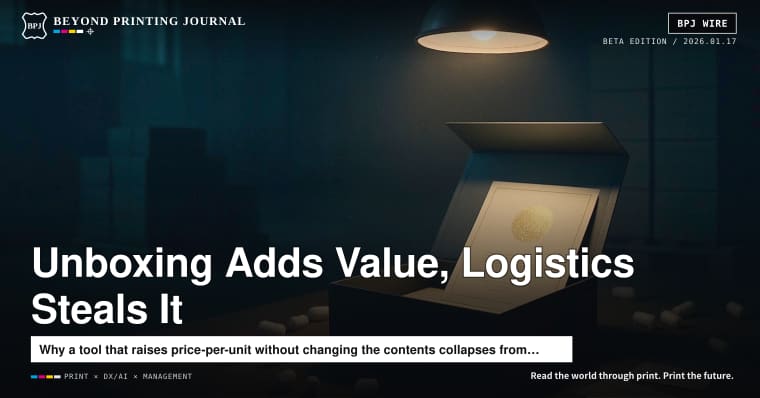
The Moment You Open the Box, the Price Goes Up: Limited-Edition Packaging Is Manufacturing “Experience Quality”
A $800+ advent calendar goes viral for the wrong reasons. A $330 advent calendar triggers complaints over missing items. High-priced “box products” don’t charge for what’s inside—they charge for the moment of opening. So when it breaks, it breaks as an experience.
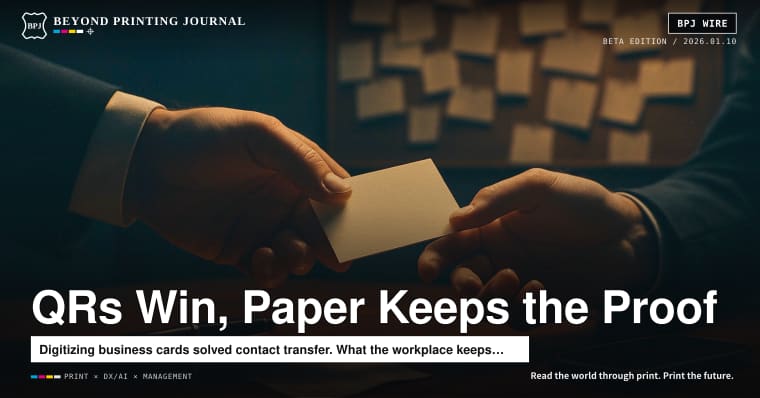
You shared your card by QR. Everyone still pulls out paper—why the “exchange” ritual leaves physical proof behind
A business card was never just a bundle of information. It was a tool for ritual. Even now that connecting by QR is normal, paper still comes out at first meetings. Why hasn’t it been replaced—and how can printing companies productize the way it’s “still here”?
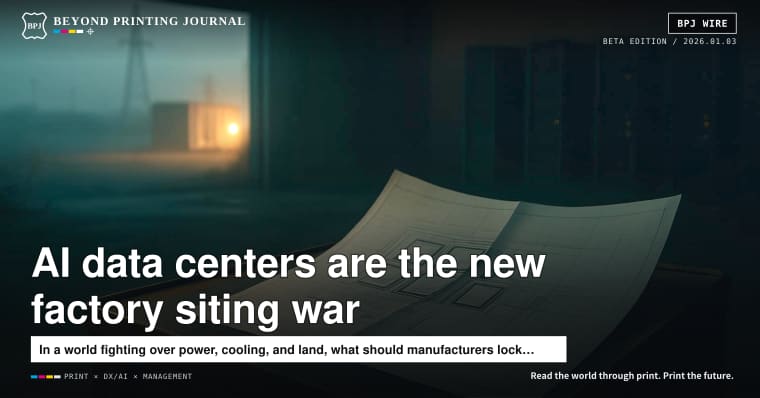
AI Data Centers Are the New Regional Factories
An AI data center isn’t just a box that holds GPUs. It is a new kind of site-selection race that shows up to claim electricity, cooling, and land as a package deal. For regional manufacturers and printing companies, the job is to spot where projects will bottleneck—before the purchase orders for physical components ever arrive.
The $1 Trillion Market That Quietly Swapped Its Contents: In 2025, the Reason to Buy Press Equipment Changed
In 2025, the global printing market was estimated at roughly $1.0 trillion. What happened on the equipment floor, though, wasn’t a simple story of “the market grew.” In the same year, some processes attracted investment while others froze—and even the order patterns of equipment makers changed shape.
Six months into consolidation clean-up: five corrugated plants sold, and an EU regulatory “gap” that will reshape the market
In H2 2025, the global print and packaging market was shaped less by macro sentiment and more by what happens after the deal closes: integration clean-up. Once mega-M&A is done, plant divestments, supply-chain rewiring, and spec rewrites begin. And inside that process, there are real profits a printing company can go win.

Before You Argue the Price, the Contract Has Already Changed: Japan Print Market Half-Year Report (H2 2025)
In H2 2025, the most consequential change in Japan’s print market wasn’t demand moving up or down. It was the “shape of the deal.” Before anyone even gets to a price increase, buyers are starting to ask first about evidence of consultation, payment terms, written purchase orders, and how spec changes will be handled.
The year paper publishing fell below ¥1 trillion: how factory labor and workflows changed
In 2025, Japan’s paper publishing market fell below ¥1 trillion. Everyone expected demand to keep shrinking. But once a symbolic threshold is crossed, it changes the buyer’s assumptions—and the work that decides whether a print plant makes money.

Paper inserts are gone from prescription drugs in Japan—so why are label failures rising?
On August 1, 2021, Japan essentially stopped requiring paper package inserts to be physically included with prescription medicines. Yet on the floor, operations still stall when an outer-box barcode won’t scan—and recalls still happen when labels are applied incorrectly. Regulation designed to reduce paper isn’t lowering paper’s value. It’s raising the barrier to entry for compliance printing.
Digitized doesn’t mean dispute-proof: the moment financial forms snap back to paper
Electronic issuance of premium deduction certificates has reached about 98.5% of life insurance policies by contract count. And yet the envelope—and the reissue counter—won’t disappear. What’s unfinished in digitization isn’t slow IT spend. It’s the trust architecture: in complaints and disputes, who is responsible, and in what form.

The catalog is your second ticket. And the wall hits at 1 kg.
The experience you saw in the gallery is a one-time sale. Add a catalog and goods, and the experience turns into something you can take home. The trouble starts the moment the catalog stops being “a book” and becomes a logistics product.
The day you switch to paper—and packaging waste still doesn’t fall
There was a time when you could say it cleanly: switch to paper and the footprint improves. On the floor, that used to be true enough. It isn’t anymore. Regulation is moving away from the simple “plastic to paper” story—and operations teams are living with the extra work that paper switches can create.

Why high-priced ZINEs win on small print runs—and why the price is set after printing
Two ZINEs can both be 30 pages—and one sells for a few hundred yen while another sells for a few thousand. The difference is not just paper or page count. Small runs can command high prices because printed matter is shifting from “something to read” to “proof of ownership and participation.”
The DTP bottleneck that turns 4,000 VDP records into an eight-hour RIP queue
Run 4,000 VDP records and the RIP queue stretches to eight hours. That shop-floor account is sitting in an overseas print community thread. At the same time, Web-to-Print is shifting from a race to build “order screens” to a race to build composition engines that make the web preview match the printed result. DTP work is starting to move from operating a UI to engineering a system where exceptions don’t happen.

Why the “Print-ready PDF (96 pages)” won’t disappear—even as e-filing becomes mandatory
Integrated reports are entering an era of mandatory electronic filing. Yet many companies still polish a PDF “for printing” and keep a paper booklet in circulation. Paper isn’t surviving on ideology. It’s being pushed into a new role—wedged between power (regulation) and money (the messy reality of disclosure work).

When paper shrinks and a printer tries to become “the side that sells information,” the enemy isn’t news—it’s billing and churn
In the US, some news startups disappeared faster than print did. The Messenger, which shut down on January 31, 2024, bet on flooding readers with general-interest news and growing on advertising—but the current had already shifted toward “niche paid subscriptions.” At the same time, more people are paying for digital news. More people are paying, and yet not everyone is saved. Inside that contradiction, where is the room for printing companies—whose “paper that distributes information” has been shrinking—to move into “selling information” instead?

When retirements can sink a company, a factory’s “judgment” becomes a product
In 2025, bankruptcies triggered by employee or executive retirements were counted as an official statistic. The problem is not simply that skills vanish; it’s that the micro-adjustments that protect quality disappear, and orders and the shop floor collapse at the same time. The opportunity for printing companies is not manual-making, but building an operation that keeps “judgment” circulating as training content plus quality data.

When ¥9 per insert is scarier than a 7% freight hike—why delivery, not printing, now decides your profit
Shaving ¥1 off your print unit price is slow. A ¥9 per-piece inserting fee—or a 7% carrier change—can wipe out margin fast. After the 2024 logistics crunch, price increases didn’t just make shipping cost more; they dragged the cost of “making it shippable” into the open. Delivery prices are moving more than print prices.

In the AI era, printed books hold the line in travel, learning—and kids
“AI will kill book sales.” In the very year people said that, one slice of Japan’s print market grew. The overall paper market is contracting. Still, the statistics call out specific categories that expanded.

That QR Code Doesn’t Prove It’s Real. So Who’s Printing the Definition of “Authentic”?
Anti-counterfeit labeling always contains a strange contradiction. Even the flashiest hologram or the smartest NFC tag loses in the end to a simple question: who issued that ID, and where is the canonical record? Proof of authenticity is being redesigned—not as a better “sticker technology,” but as delegated power.
The Deadline Industry Moves 3.37 Billion Pieces: Why Posters and Direct Mail Survive Even “Digital” Elections
Sometimes an election really starts not on a social feed, but in front of a guillotine cutter and an inserter. In the US in 2024, Political & Election Mail totaled 3.37 billion delivered pieces. Paper persists in the digital era not because of ideology, but because of deadlines, institutions, and distribution.
2,133 label swaps: Allergen recalls happen more in “applying” than in “printing”
In prepared foods and private-label retail, accidents often start before flavor or formulation—when the wrong label gets applied. The trigger for a recall is frequently not the product itself, but tiny actions: apply, overprint, replace. Regulatory change also forces awkward shifts in inventory timing and plate/version control, raising the odds of a mistake.
Collab cafés are mass-producing paper rituals
A collaboration café has been built in as a permanent “function” of prime real estate in Shibuya. What’s driving the change isn’t acrylic stands or posters. It’s the machinery of “belonging rituals”—proof of participation, distribution rules, and even collection and resale—that is starting to decide who wins and loses short-run events.
How to govern a company that already has seven AIs inside it
When a printing plant has a “wrong plate” incident, the root cause is often boring. Someone didn’t use the latest version. A check sheet was skipped. A change history didn’t exist. The same structure is now showing up in in-house AI.

Profit Up, Sales Flat: What Big Printers’ Earnings Reveal About Inserts, Price Hikes, and Ramp‑Up Risk
Even among Japan’s “big printing” groups, some companies grow sales and still see profit fall. Others lift operating profit faster than revenue. What earnings releases describe isn’t the economy—it’s redesigned workflows: price revisions, structural reform, and mix improvement. This piece unpacks where those levers are working across packaging, BPO, and electronics, using the numbers as the map.
Why $7 billion just landed in the “wrapping factory”
In Peoria, Arizona, Amkor has announced the groundbreaking of an advanced packaging and test site, with investment up to $7 billion. What’s happening in semiconductors right now is a shop-floor reality: winning at miniaturization alone is no longer enough. To hit performance targets, the “assemble and wrap” stages have become the bottleneck—and value is starting to migrate downstream.

The envelope was a donation payment terminal
An envelope isn’t just paper packaging. For religious groups and nonprofits, it can function as a “payment terminal” that renews affiliation, collects small gifts, and leaves a physical memory. The risk isn’t religious intensity. It’s that the moment postal rules and production steps slip, the terminal flips into a loss-making machine.

18 months into Japan’s invoice regime, the “tax‑exempt vendor switch” still isn’t done
After Japan’s invoice system went live, there are moments on the shop floor when you want to say, “We’ve already sorted out the tax‑exempt subcontractors.” But the National Tax Agency’s filing statistics suggest the switch didn’t end with “registration.” What erodes a printing company’s gross margin is not the tax rate—it’s the moment the documentation chain needed to claim input tax credits snaps somewhere in the outsourced process.

DPP Doesn’t End With a QR Code: Who Owns the Update Obligation?
If you put a 2D code on a box or a nameplate, the Digital Product Passport (DPP) feels “done.” Think that way, and 18 February 2027 suddenly gets heavy. In batteries, that’s the day a system goes live where economic operators must ensure the information is accurate, complete, and up to date.

Grading and vaulting: the machinery that turns paper cards into assets
The moment a printed card becomes a graded item—sealed in a tamper‑resistant slab—it gets a different price tag. As trading cards scaled, the fattest growth wasn’t in the cards themselves, but in the process that “issues trust”: authentication, grading, sealing, and storage. For printing companies, the opportunity is not print volume. It’s the fee faucets in grading, vaulting, and distribution.
Annual Report 2024: Capex shifted from “more capacity” to “replacing steps”
If you want to understand Japan’s domestic print market in 2024, start less with “how demand moved” and more with “where the machines went.” It was a year when investments leaned not toward new lines for higher output, but toward reshaping existing plants into a different kind of capacity. Even while the annual figures are not fully extractable, putting four yardsticks—equipment, paper, financial results, and exits—into one frame makes the next move clearer.

In 2024, global print demand drifted toward “the politics of boxes” and bigger buyers
In 2024, the print market wore a neutral face—neither recession nor boom. But line the year up month by month and the center of gravity quietly moved. It was a year when packaging regulation as a political event, and consolidation among corrugated giants, started changing specifications and purchasing units at the same time.
The Year the Backlog Vanished: Global Print Competed on Uptime Quality, Not Press Count
In 2023, the mood in global print changed first through equipment, not macro headlines. The machines people had waited for finally arrived and backlogs unwound. At the same time, new orders normalized—and the old assumption returned: volume won’t suddenly surge. Over the year, investment logic began shifting from “add capacity” to “raise the quality of runtime.”
In 2023, print production started being decided by “people”
Let’s revisit Japan’s 2023 print market not from “demand up/down,” but from two fixed points: labor and process. A rise in closures and dissolutions doesn’t just make headlines—it quietly thins subcontracting networks and downstream capacity. We translate year-only trend lines into inputs for investment and order-acceptance decisions.
In 2022, the center of the estimate shifted—from “paper” to “terms”
In 2022, updating a “paper price list” stopped being enough for a printing company’s quotation to keep up. The price shock began with paper, but what squeezed plants was the simultaneous movement of freight, energy, materials—and procurement terms such as lead time and lot size. Look at the year as a whole and a trend line emerges: as demand fell while costs rose, the source of profit began to shift from “printing” to “procurement design.”
In 2022, printing companies weren’t acquired first—their profit boundaries were
In 2022, the print market changed shape before demand fully returned—because of supply-side constraints in materials, labor, and energy. Top-line numbers held up through price increases and mix, while companies redrew “where we make money” via M&A and segment restructurings. The question for printers isn’t revenue up or down. It’s where the boundary moved—the line where profit actually stays.
Bankruptcies Fell in 2021. Factory Headcount Didn’t Rise—Japan Print Market Annual Report 2021
Japan’s domestic print market in 2021 was the year a gut instinct started to fail: “If work comes back, the plant will run.” Bankruptcies were pushed down to historic lows, and skilled labor didn’t spill into the market. Meanwhile buyers shifted their center of gravity from paper to digital, and from big lots to setup work. Before demand fully recovered, shop floors began rebuilding workflows around a hard limit: people.
Price hikes moved from “negotiation” to “clauses.” In 2021, global print survived by rewriting contracts
If you describe the 2021 print market as simply “demand came back / didn’t come back,” you miss the change that mattered. Materials, logistics, and energy rose at the same time—and pricing stopped being a favor to ask for and started being engineered as contract language. What you can only see when you look at the year as a whole is not the increase itself, but the route by which the mechanisms that make increases stick came down to the shop floor.
The Year Print Shrunk—But Label Plants Kept Getting Bought
In 2020, printing companies around the world hit the brakes at the same time. Yet in one corner, plants kept getting bought; in another, investment froze; and elsewhere, exits suddenly felt defensible. In the year the market contracted, the real story wasn’t demand shift by itself—it was the widening gap in decision speed.
In 2020, print quotes stopped fighting on “unit price” and ran to “terms”
In Japan’s print market in 2020, it wasn’t only demand that fell. Lead times, quantities, cancellations, split deliveries, documentary proof—terms that sit outside the line items on a quote became the difference between profit and loss. Looking year over year with the same yardstick, you can see the place printers needed to defend shifted before paper prices did.